30 Years in the Mouth: How Dental Hygiene Has Changed—and Why the Human Connection Still Matters
October is Dental Hygiene Month.
And this year, I find myself looking back.
Thirty years ago, I was a young dental hygienist with a new BSDH, a lot of enthusiasm, and absolutely no idea what the next three decades would bring.
Sometimes I think about how different our world of dental hygiene was then.
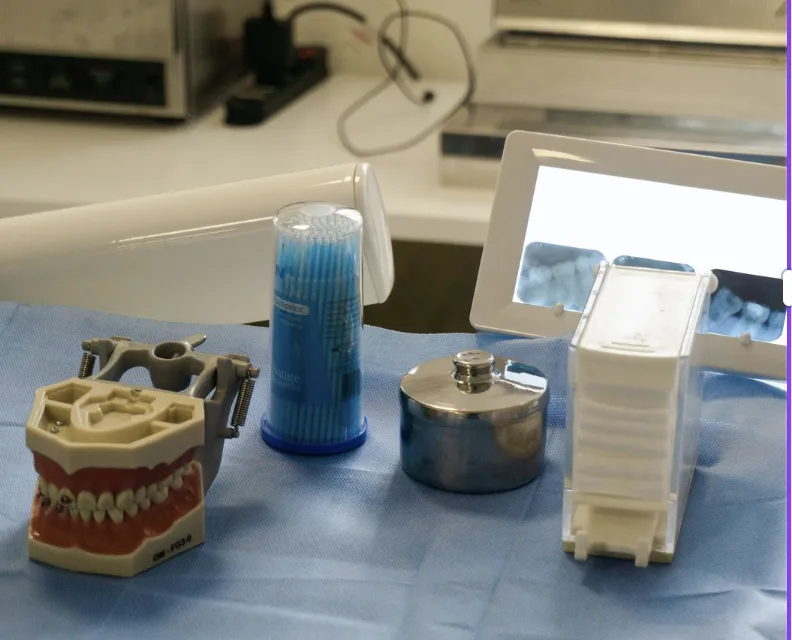
I remember developing X-rays in a darkroom.
Yes...the actual darkroom.
You’d walk in, turn off the lights, and work with those chemicals while waiting for the image to develop. It was part of the routine.
And honestly?
That little darkroom could serve another purpose too.
It was sometimes our quiet time.
And sometimes…
it was where the gossip was.😂
You’d step into that darkroom and suddenly hear all the things that apparently couldn’t be said in the operatory.
No digital sensor.
No instant image popping up on a computer screen.
No clicking through an electronic chart while your patient waited.
Just film, chemicals, a darkroom, and a few minutes to breathe.
Looking back, those little moments make me smile because they remind me just how much dental hygiene has changed.
From film to digital
Today, we have digital radiography, intraoral cameras, electronic/ ai periodontal charting, sophisticated practice-management systems, advanced diagnostics, patient communication platforms, and technology that can put information in front of us almost instantly.
The pace is different.
The expectations are different.
The science is different.
And now we’re entering another major chapter with artificial intelligence.
But here’s something 30 years has taught me:
Technology changes the way we work. It doesn’t change why we work.
We’re still caring for a person sitting in front of us.
The hygienist’s role has grown
When I started, the traditional image of the hygienist was pretty simple:
Clean the teeth. Take X-rays. Polish. Floss. Educate. See you in six months.
But we’ve learned so much since then.
We understand more about periodontal disease and inflammation. We’re talking about oral-systemic connections, diabetes, cardiovascular health, nutrition, smoking and vaping cessation, sleep, airway concerns, behavioral health, and the impact of stress on health.
We’re assessing risk.
We’re communicating with other healthcare professionals.
We’re educating patients who can find thousands of pieces of health information online before they ever sit in our chair.
And we’re learning how to care for the whole person, not just the mouth.
Then COVID changed the trajectory
And then came 2020.
COVID changed dental hygiene in ways none of us could have predicted.
Aerosols became a household word.
PPE looked completely different.
Infection control took on another level of importance.
Waiting rooms, scheduling, screening, ventilation, patient flow, and even the simple act of sitting face-to-face with a patient had to be reconsidered.
For hygienists, it was particularly personal.
We work incredibly close to people’s faces and spend our days working inside the mouth This is the very environment where concerns about aerosols and transmission were suddenly front and center. ( We weren't considered Frontline Heros )
But COVID also made me look at my own career differently.
It made me ask:
What else can I do with 30 years of knowledge, experience, and connection with patients?
How do I reach the person who isn’t coming into the dental office?
How do I help someone who is afraid before they ever sit in the chair?
How do I use my voice beyond the operatory?
Those questions changed my trajectory.
Because dental fear hasn’t changed as much as technology has
We may have gone from film to digital.
From paper charts to electronic records.
From developing X-rays in a darkroom to images appearing instantly.
But one thing hasn’t changed:
People can still be afraid of the dentist.
And sometimes that fear has nothing to do with the procedure itself.
It’s about a previous experience.
Feeling judged.
Feeling embarrassed.
Not being listened to.
A painful childhood memory.
A lack of control.
Trauma.
Shame.
Or simply not knowing what is going to happen next.
After 30 years, I’ve learned that you can’t always tell someone’s story by looking at their teeth.
The patient who hasn’t been to the dentist in 10 years has a story.
The person gripping the chair has a story.
The patient who apologizes for their teeth before you’ve even looked in their mouth has a story.
And the patient who jokes through the entire appointment because they’re nervous?
Yep.
They have a story, too.
What hasn’t changed
For all the advancements in dental hygiene, there is something that hasn’t changed since I was that young hygienist walking into the profession 30 years ago.
The human connection still matters.
Technology can help us see more.
AI can help us recognize patterns.
Digital systems can help us communicate and organize information.
But none of those things can replace looking at a patient and saying:
“I hear you.”
“You’re not being judged.”
“Let’s take this one step at a time.”
That’s where the real work happens.
Thirty years later…
I sometimes miss that darkroom.
Not necessarily the chemicals or waiting for film to develop, but the simplicity of it.
The pause.
The quiet.
And yes, maybe even the gossip. 😂
But I wouldn’t trade what we’ve learned.
I’ve watched dental hygiene evolve from a profession heavily focused on cleaning and prevention into one that increasingly understands the connection between oral health, overall health, behavior, environment, technology, and human experience.
And I believe we’re still evolving.
The next generation of hygienists will work with technologies we couldn’t have imagined when I was developing X-rays in that darkroom.
But I hope we never lose the most important technology of all:
Listening.
Because behind every set of teeth is a person.
Behind every patient is a story.
And sometimes, what that person needs most isn’t another piece of information.
They need someone to give them Hope.
Happy Dental Hygiene Month.
Thirty years in and I’m still learning, still listening, still growing, and still believing in the power of a hygienist to make a difference.
Hope Loyd, BSDH, RDH
Gum Goddess | Host,Gums & Gossip™
President-Elect AADH 2026-2028
Fear Less. Smile More.
Every smile shares a story.